

Why Construction Worker Rights Matter for Your Safety and Livelihood
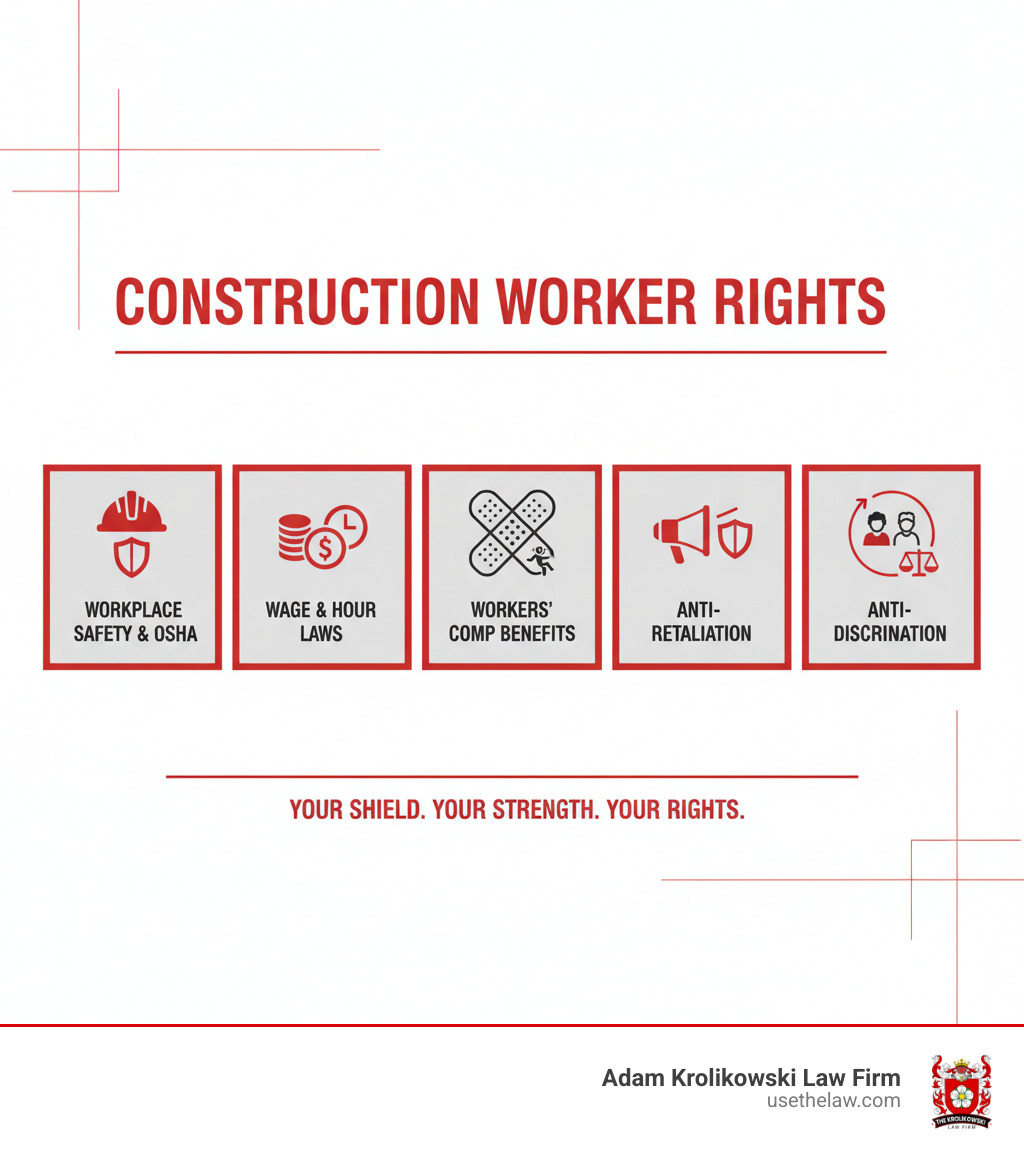
Construction worker rights are legal protections ensuring you receive fair pay, work in a safe environment, and have recourse when things go wrong. Here’s what you need to know:
Your Core Rights as a Construction Worker:
- Workplace Safety – OSHA protections, safe equipment, proper training, and the right to refuse dangerous work
- Fair Pay – Minimum wage, overtime at 1.5x rate after 40 hours, prevailing wages on public projects
- Workers’ Compensation – Medical care and wage replacement if you’re injured on the job
- Freedom from Retaliation – Legal protection when you report safety violations or file complaints
- Anti-Discrimination – Protection regardless of race, gender, age, disability, or immigration status
Construction sites are hazardous. Falls are the leading cause of fatalities in construction, accounting for about one-third of all industry deaths. In 2023, 96 of the 345 fall-related workplace deaths were in construction.
Many workers, including day laborers, temporary staff, and long-term employees, are unaware of their legal protections. Federal and state laws guarantee your rights to safe conditions, minimum wages, and the ability to file complaints without fear of job loss.
These rights apply regardless of your immigration status or employment type. Both staffing agencies and host employers are responsible for your safety. You have the right to request OSHA inspections, refuse imminently dangerous work, and seek compensation for injuries.
Knowing your rights helps you get home safely and receive the pay you’ve earned. When employers cut corners, workers can face serious injuries, medical debt, and lost wages that threaten their financial stability.
Basic construction worker rights terms:
Your Fundamental Right to a Safe Workplace Under OSHA
Construction sites are inherently risky, which is why the Occupational Safety and Health Administration (OSHA) exists to protect you. Under the Occupational Safety and Health Act of 1970, your employer has a legal duty to provide a workplace free from serious recognized hazards. This is known as the General Duty Clause.
These construction worker rights apply to everyone on the job site, including full-time, temporary, and day laborers, regardless of immigration status. The law protects all workers.
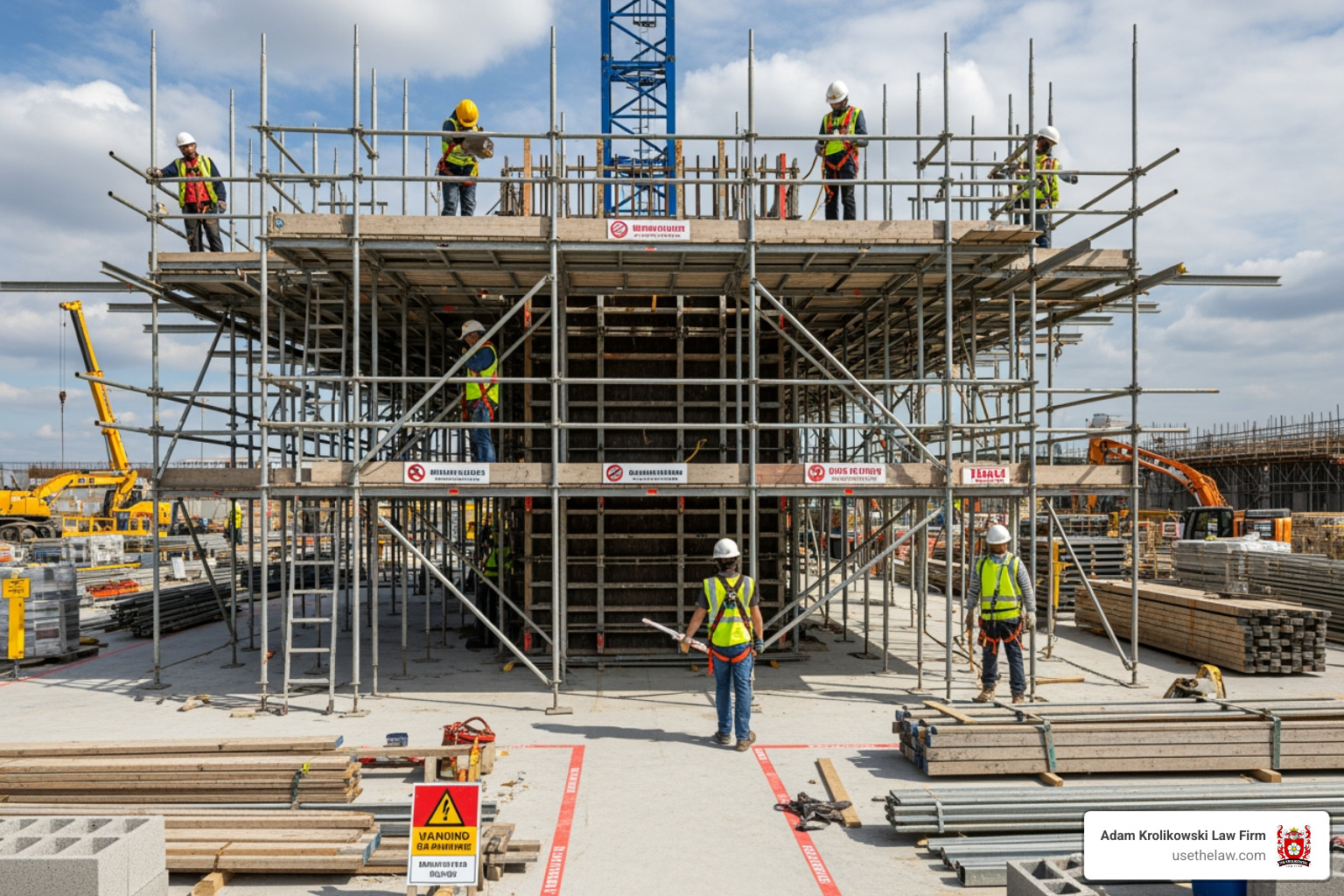
Employer Responsibilities for Site Safety
Your employer has a comprehensive legal obligation to keep you safe. This includes:
- Providing a hazard-free environment by actively identifying and fixing or controlling known job site dangers.
- Supplying safe tools and equipment that are well-maintained, appropriate for the job, and monitored for safe use.
- Providing Personal Protective Equipment (PPE) like hard hats, safety glasses, and fall protection systems at no cost to you, and training you on its proper use.
- Conducting regular inspections of the worksite to find and fix hazards before they cause injuries.
- Keeping accurate records of injuries and illnesses to identify hazard patterns and prevent future accidents.
- Providing hazard information and training in a language you understand. This must cover specific dangers like falls, electrocutions, and chemical exposure. On many large sites, workers are entitled to at least 40 hours of safety training before starting work.
Your Rights During an OSHA Inspection
If you believe your worksite is unsafe, you have rights during an OSHA inspection. You can:
- Request an inspection by filing a confidential complaint with OSHA, especially if your employer ignores your safety concerns.
- Speak privately with the inspector to share information without your employer present.
- Have a worker representative join the inspector during the walkthrough to point out hazards.
- Review the inspection results, including any tests conducted for workplace hazards.
- Have your identity protected by requesting OSHA keep your name confidential when you file a written complaint.
The Right to Refuse Unsafe Work and Report Violations
One of your most important protections is the right to refuse work that poses an immediate and serious risk of death or severe physical harm, such as working on unstable scaffolding.
Before refusing, you should notify your employer of the hazard and give them a chance to fix it, unless the danger is too immediate to wait.
Protection from retaliation is guaranteed by law. Your employer cannot fire, demote, or otherwise punish you for complaining to OSHA, participating in an inspection, or exercising your safety rights.
If you face retaliation, you have whistleblower rights. You can file a whistleblower complaint with OSHA, but you must act quickly, as these complaints generally must be filed within 30 days of the retaliation. For guidance, visit How to file a whistleblower complaint for retaliation.
Understanding Your Paycheck: Wage, Hour, and Leave Rights
Fair pay for every hour worked is a fundamental right, yet wage theft is a common problem in construction. The Fair Labor Standards Act (FLSA) is a federal law that establishes minimum wage, overtime, and compensation rules. These are legal requirements, not suggestions.
Wage theft can be subtle, such as failing to pay for pre-shift prep time, required meetings, or overtime hours. Understanding your rights is the first step to ensuring you receive every dollar you’ve earned.
Minimum Wage and Overtime Requirements
The FLSA sets the federal minimum wage, but your employer must pay the higher state or city rate if one applies, such as in New York City or Colorado.
Overtime pay at 1.5 times your regular rate is required for any hours worked beyond 40 in a single workweek. This is calculated weekly, and employers cannot illegally “average” your hours over two weeks to avoid it. If you work 50 hours one week and 30 the next, you are owed 10 hours of overtime for the first week.
Compensable “hours worked” includes time spent on any activity for your employer’s benefit, such as putting on safety gear, attending mandatory meetings, or traveling between job sites during the day.
Most construction workers are entitled to overtime, even if paid a salary. Exemptions for executive, administrative, or professional roles have strict duty and salary requirements that most on-site workers do not meet.
Prevailing Wages on Public Works Projects
If you work on publicly funded projects like schools or highways, you are often entitled to higher “prevailing wages.”
The federal Davis-Bacon Act (and similar state laws) requires contractors on public projects to pay you the local prevailing wage for your trade, plus fringe benefits. These rates are typically much higher than minimum wage, reflecting local market rates for skilled labor.
Rates also include a fringe benefit amount for health insurance, pensions, or training. Your employer must provide these benefits or pay you the equivalent amount in cash.
How to Protect Yourself from Wage Theft and Misclassification
Employers sometimes misclassify workers as “independent contractors” to avoid paying overtime, workers’ comp insurance, and taxes. This denies you critical construction worker rights.
If your employer controls when, where, and how you work, you are likely an employee. True independent contractors run their own business and control their own work.
California’s strict “ABC” test presumes you are an employee unless your employer can prove all three of the following: (A) you are free from the company’s control, (B) your work is outside the company’s normal business, and (C) you have your own independent business in that trade.
Protect yourself by keeping detailed records of all hours worked. Employers cannot make illegal deductions from your pay, such as charging for required tools or safety gear if it drops your pay below minimum wage.
If you face wage theft or misclassification, the Department of Labor’s Construction Industry Compliance Assistance Toolkit offers resources and information on filing complaints.
Special Protections for Temporary and Contract Workers
The construction industry uses a mix of permanent and temporary workers. If you’re hired through a staffing agency, both the agency and the host company are typically responsible for your safety.
This “joint employment” means you have the same safety and health protections as permanent employees, with two entities legally obligated to protect your construction worker rights.
What is ‘Joint Employment’ and Who is Responsible?
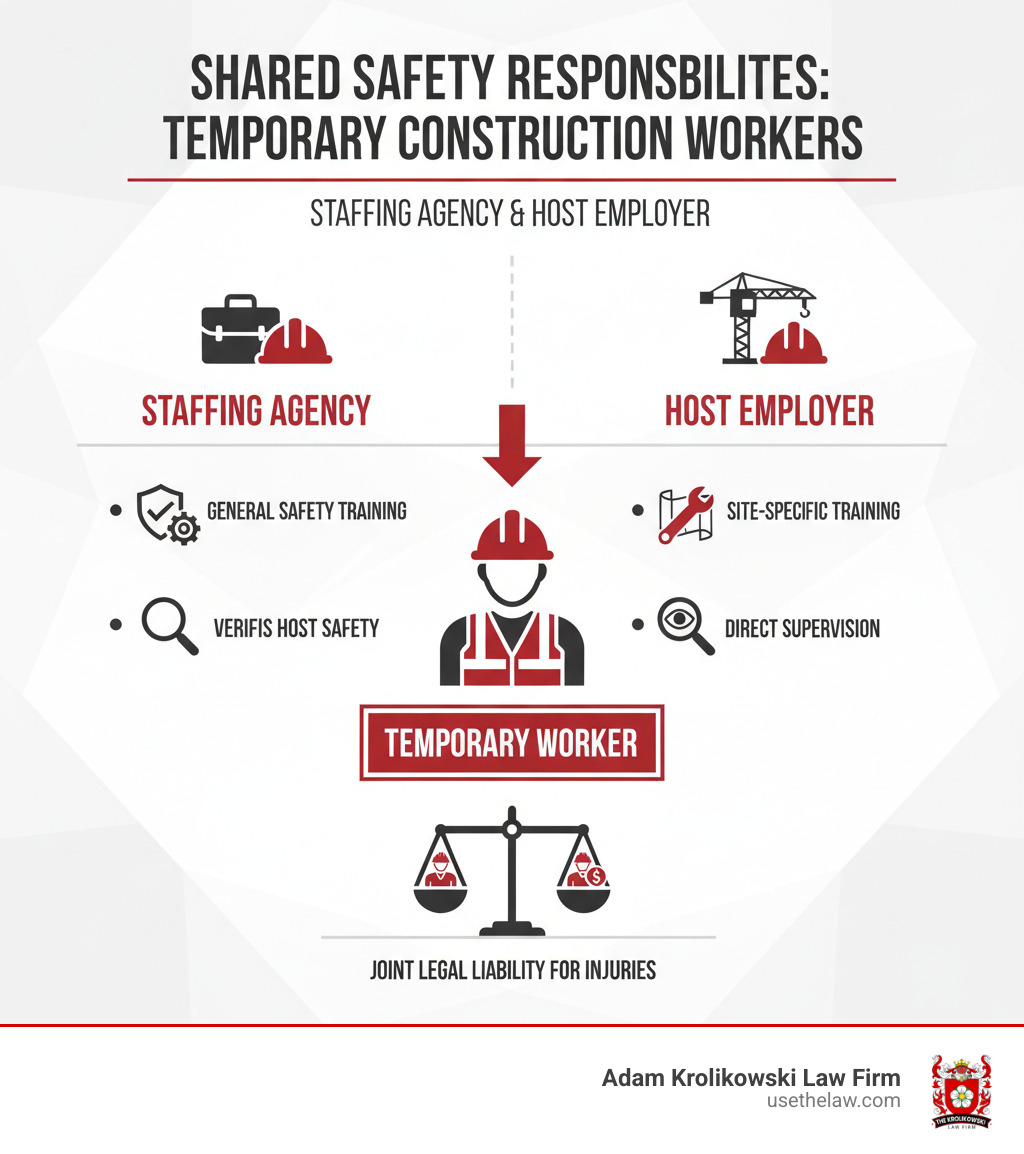
Joint employment means the staffing agency and the host employer (the construction company) are both considered your employer under the law and share legal responsibility for your safety and well-being.
The staffing agency should provide general safety training and verify that the host employer’s site is safe before sending you. They cannot simply drop you off at a worksite and ignore their responsibility.
The host employer controls the worksite and is responsible for site-specific training on their unique hazards, equipment, and emergency procedures, as they directly supervise your daily work.
Crucially, if you are injured on the job, both the staffing agency and the host employer can be held legally liable. This gives both a strong incentive to prioritize your safety.
Key Differences in Safety and Training Duties
While responsibility is shared, the staffing agency and host employer have distinct roles.
| Responsibility Area | Staffing Agency Responsibilities | Host Employer Responsibilities |
|---|---|---|
| General Safety Training | Provide general safety and health training (e.g., hazard communication, basic PPE use) | Ensure temporary workers receive general safety training from staffing agency and supplement as needed. |
| Site-Specific Training | Verify that the host employer provides adequate site-specific training. Inquire about hazards at the host site. | Provide comprehensive site-specific training on hazards, equipment, and emergency procedures unique to their worksite. |
| Hazard Communication | Inquire about hazards at the host site and communicate relevant general hazards to workers. | Inform temporary workers about all known hazards on their site, including chemical, physical, and environmental risks. |
| PPE Provision | Provide basic PPE (e.g., hard hats, safety glasses) as needed for general construction work. | Provide specialized PPE required for specific tasks or hazards on their site and ensure its proper use, maintenance, and fit. |
| Supervision | General oversight of worker placement and suitability. | Direct supervision of temporary workers, ensuring they follow safety protocols and use equipment correctly. |
| Accident Investigation | Cooperate with host employer in accident investigations, provide worker information. | Lead accident investigations for incidents on their site, identify root causes, and implement corrective actions. |
| Recordkeeping | Maintain records of general training provided, worker placements. | Maintain records of site-specific training, injury/illness logs for all workers, including temporary staff. |
In short, the staffing agency provides general safety knowledge, while the host employer provides specific training for their site. What matters for you is that you have the right to speak up. If you feel unsafe or lack training, you can ask questions or refuse dangerous work without fear of retaliation. Your temporary status does not diminish your rights; the law provides you the same safety protections as permanent employees.
When Accidents Happen: Workers’ Compensation and Injury Rights
Accidents can happen even on safe construction sites. If you’re hurt, you have construction worker rights to medical care and wage replacement. At the Adam Krolikowski Law Firm, we have helped injured construction workers in Orange County steer these situations for over 25 years.
Workers’ Compensation and Your Construction Worker Rights After an Injury
Workers’ compensation is a no-fault insurance system providing benefits regardless of who caused the accident. In California, this system prioritizes getting you help quickly.
After getting medical attention, report the injury to your employer immediately, preferably in writing. While California law gives you 30 days, waiting can complicate your claim. Your employer must provide a claim form (DWC-1). Completing and returning it promptly starts the process.
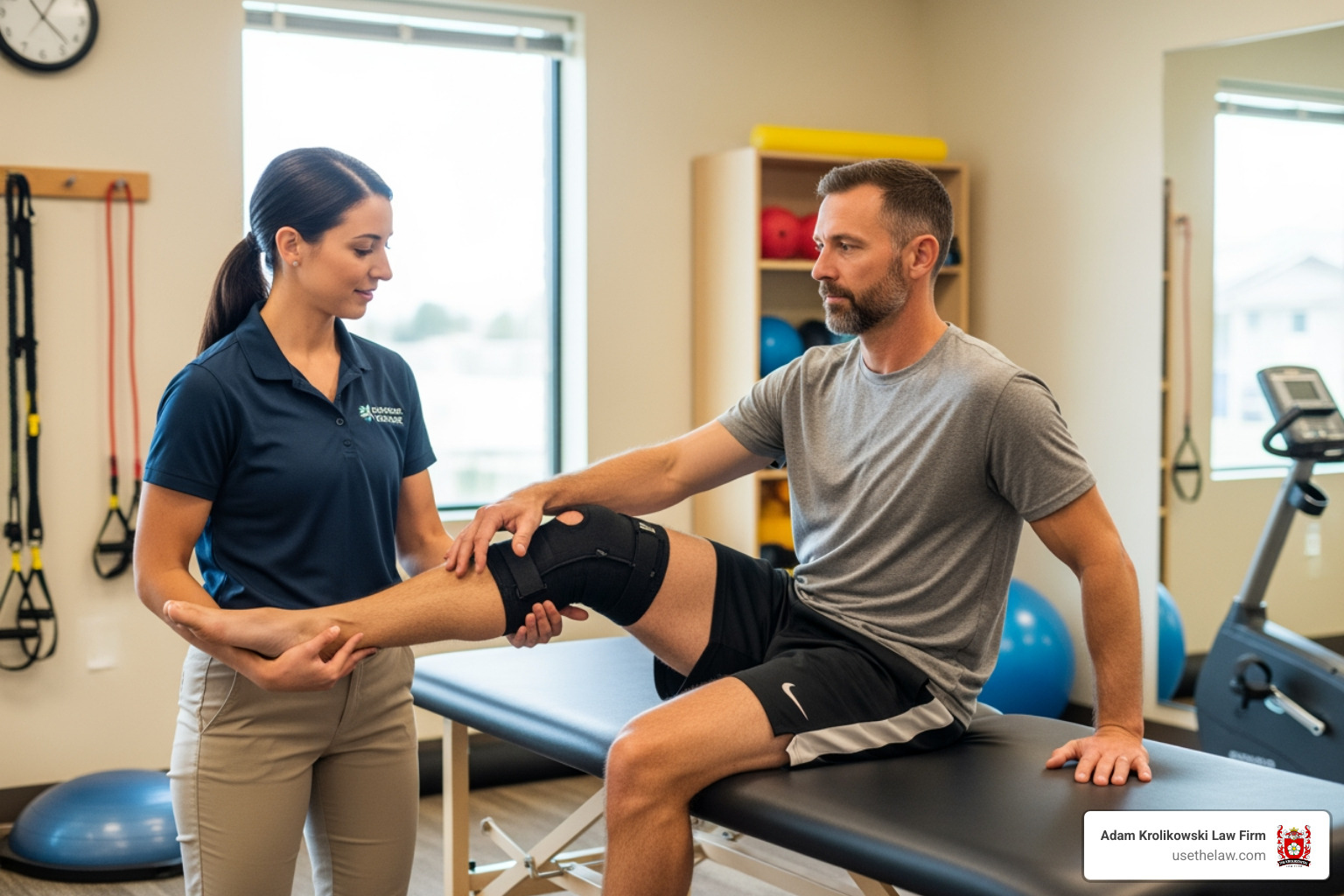
Benefits typically include all necessary medical care, temporary disability payments to replace a portion of lost wages, and permanent disability payments for lasting impairments.
In exchange for these no-fault benefits, you generally cannot sue your employer for other damages like pain and suffering. This is why exploring all legal options is critical.
Beyond Workers’ Comp: When Can You File a Personal Injury Lawsuit?
Workers’ comp benefits are helpful but often don’t cover the full impact of a serious injury. You may have legal options beyond workers’ comp.
When someone other than your direct employer or a co-worker caused your injury, you can pursue a third-party personal injury lawsuit. A construction site involves many parties: general contractors, subcontractors, equipment manufacturers, and property owners. If their negligence caused your injury, they can be held liable.
Common sources of third-party claims include:
- Defective equipment: If a faulty tool, scaffold, or safety harness caused your injury, the manufacturer can be held responsible under product liability laws.
- Negligent subcontractors: If a different subcontractor on site created a hazard that led to your injury, they may be liable.
- Property owners: They can be held responsible for injuries caused by unsafe conditions on their land not under your employer’s control.
- General contractors: While often immune from lawsuits by a subcontractor’s employees, exceptions exist if they retained control over safety and acted negligently.
A successful third-party lawsuit allows you to recover damages not available through workers’ comp, including for pain and suffering, emotional distress, and full lost earning potential. These damages can provide financial security after a life-altering injury.
If you’ve been injured on a construction site in Orange County, Santa Ana, or Los Angeles, evaluating a potential third-party claim is crucial. We handle complex cases involving multiple parties and insurance companies, seeking to maximize your recovery. With over 25 years of experience, we are prepared for the complicated legal questions these cases present.
Upholding All Construction Worker Rights: Discrimination and Legal Recourse
Federal and state laws protect construction workers from discrimination and harassment, ensuring a fair and respectful workplace for everyone. These construction worker rights are enforced by agencies like the Equal Employment Opportunity Commission (EEOC).
Protections Against Workplace Discrimination
Your protections from illegal workplace discrimination include:
- Protected classes: Federal and California laws prohibit discrimination based on race, color, religion, sex (including pregnancy and gender identity), national origin, age (40+), disability, or genetic information.
- Harassment: Employers must have anti-harassment policies and act when it’s reported. Harassment includes offensive conduct, slurs, or threats that create a hostile work environment.
- Employer liability: An employer can be held liable for harassment, especially if they knew or should have known about the conduct and failed to act.
- Respectful workplace: Employers are responsible for fostering an inclusive and respectful environment where all workers feel safe.
- Immigration status: All your rights, including protection from discrimination and wage theft, apply regardless of your immigration status. An employer cannot use your status to exploit you.
What to Do If Your Construction Worker Rights are Violated
If you believe your rights have been violated, it is important to act.
- Document everything: Keep detailed records of all incidents, including dates, times, locations, people involved, and what happened. Save related texts, emails, or photos.
- Report internally: Report the issue to your supervisor or HR according to company policy. This gives your employer a chance to fix the problem.
- File a formal complaint: If the issue isn’t resolved, file a complaint with the appropriate agency: OSHA for safety issues, the Department of Labor (DOL) for wage violations, or the EEOC (and California’s DFEH) for discrimination.
- Seek legal advice: These processes are complex. An attorney who understands construction worker rights can explain your options, help gather evidence, and represent your interests.
- Act quickly: Strict deadlines, known as statutes of limitation, apply to filing claims and lawsuits. Missing a deadline can prevent you from pursuing your case, so it is essential to act promptly.
Conclusion
Your hard work builds our communities. Understanding your construction worker rights is essential to protecting your health, livelihood, and family.
As we’ve covered, you have the right to a safe workplace, fair wages, freedom from retaliation when you speak up, and a workplace free from discrimination. These legal protections belong to you, regardless of your employment or immigration status.
Knowing your rights is the first step; taking action when they are violated is the next. If you’ve been injured, denied wages, or faced unsafe conditions or discrimination, you don’t have to handle it alone.
If you’re in Orange County and believe your construction worker rights have been violated, or if you’ve been injured on a construction site, the Adam Krolikowski Law Firm is here to help. With over 25 years of experience in complex personal injury, workers’ compensation, and employment law cases, the firm understands the challenges construction workers face. They take on complicated cases that others might turn away, fighting to get you the compensation and justice you deserve.
Your work builds our communities. Let us help protect you while you do it. Contact an Orange County construction accident lawyer for a consultation.