

Why Employee Rights Protection Matters in Today’s Workplace
Employee rights protection forms the backbone of fair and safe working conditions. Across America, federal and state laws guarantee specific protections that your employer cannot take away.
Key Employee Rights You Need to Know:
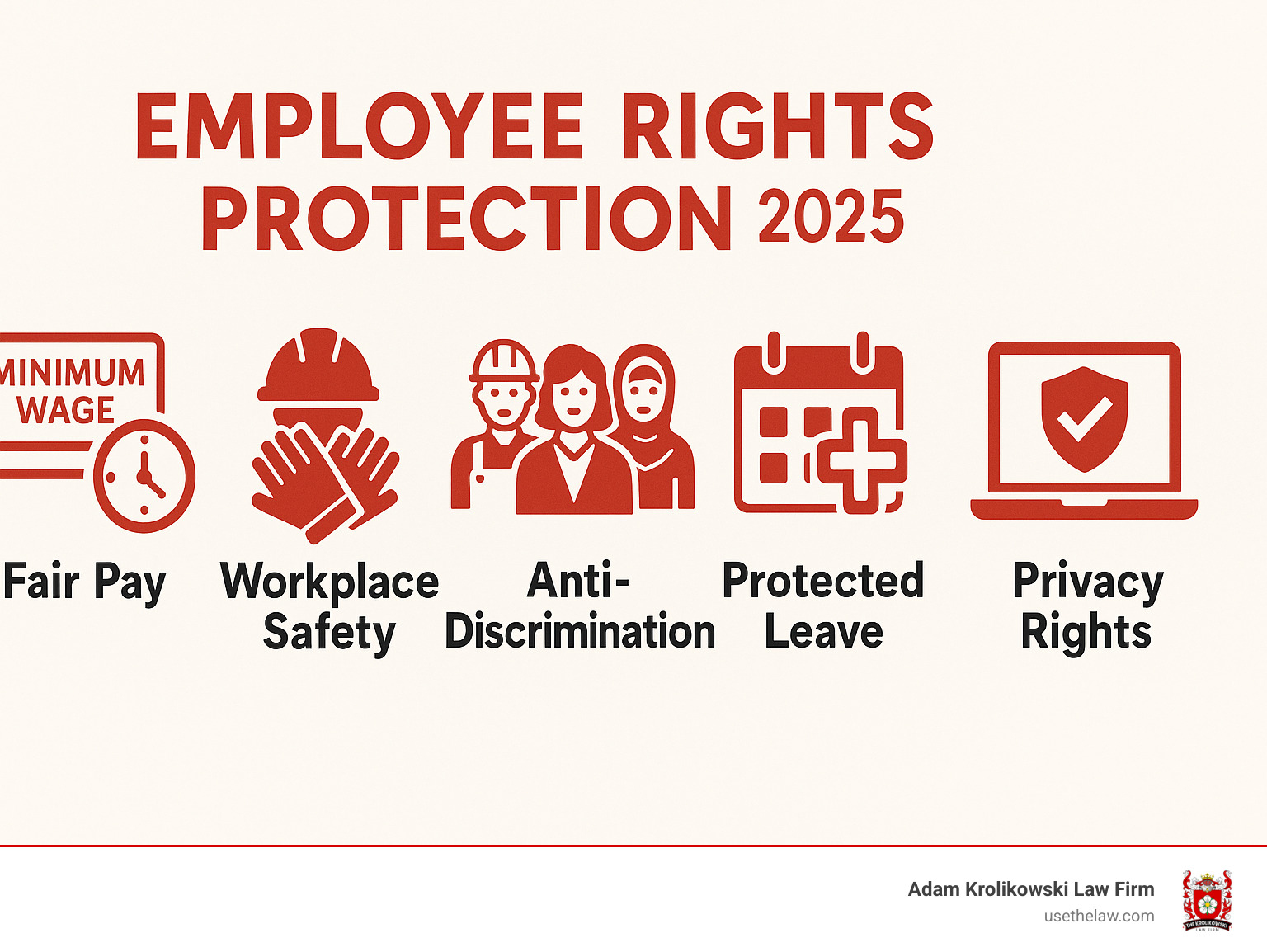
- Fair Pay – Minimum wage, overtime compensation, and equal pay for equal work
- Workplace Safety – Safe working conditions and the right to refuse dangerous work
- Anti-Discrimination – Protection from harassment based on race, gender, age, disability, and other characteristics
- Protected Leave – Time off for medical issues, family emergencies, and childbirth
- Privacy Rights – Limits on workplace monitoring and surveillance
- Collective Action – The right to organize and bargain collectively with your employer
Recent data shows that 70% of employees experience some form of digital monitoring at work, while workplace injuries affect millions annually. Understanding your rights is essential for protecting your livelihood and well-being.
Many workers don’t realize they have these protections until something goes wrong, such as a workplace injury, unfair treatment, or wrongful termination. Knowledge of your rights gives you the tools to take action and hold employers accountable.
In California, state laws often provide stronger protections than federal requirements. This means workers in Orange County and Los Angeles have multiple layers of legal protection designed to ensure workplace fairness.
Core Pillars of Employee Rights Protection
Your fundamental rights at work are a safety net, designed to ensure you’re treated fairly and compensated properly.
Fair Pay and Working Hours
Employee rights protection starts with fair pay for every hour you work. The federal Fair Labor Standards Act (FLSA) establishes the baseline for minimum wage and overtime, but the California Labor Code often provides stronger protections.
Minimum wage laws ensure you earn at least the legal minimum for your area. While the federal minimum is $7.25 per hour, California’s rates are typically much higher.
Overtime pay guarantees at least time-and-a-half your regular rate for working more than 40 hours in a week. California law also provides overtime for working more than 8 hours in a single day.
In California, you are also entitled to a 10-minute paid rest break for every four hours worked and a 30-minute unpaid meal break if you work more than five hours. These are legally required.
Pay equity laws mandate that your gender, race, or other protected characteristics do not affect your compensation. You should receive the same pay as a colleague for substantially similar work.
Any deductions from your paycheck must be required by law (like taxes) or have your written agreement. If you suspect a pay issue, document everything, including pay stubs and time records. For more info about wage and hour laws, resources are available to help.
Workplace Health and Safety
The Occupational Safety and Health Act (OSHA) and California’s Cal/OSHA exist to ensure your workplace doesn’t put your health at risk.

Your employer must provide a workplace free from recognized hazards. This includes following all safety standards, providing training about hazards in a language you understand, and supplying necessary Personal Protective Equipment (PPE) at no cost to you.
You have the right to refuse unsafe work if you believe it presents an immediate danger, especially if you’ve already reported the concern and it hasn’t been fixed. You can also file confidential complaints with OSHA or Cal/OSHA. It is illegal for your employer to retaliate against you for reporting safety issues.
Workplace safety violations can affect other aspects of your employment. California workplace safety violations impact workers’ comp claims in significant ways.
Protected Leave and Reinstatement
When you need time off for a serious illness, a new child, or to care for a sick family member, you shouldn’t have to worry about losing your job. The Family and Medical Leave Act (FMLA) and California’s Family Rights Act (CFRA) provide crucial job protections.
These laws cover:
- Medical leave for your own serious health condition.
- Maternity and parental leave to bond with a new child.
- Family care leave for a spouse, child, or parent with a serious health condition.
- Military family leave for emergencies related to a family member’s deployment.
Upon your return, you have the right to reinstatement to your original job or a comparable position with the same pay, benefits, and conditions. You are not required to accept a job that isn’t truly comparable. However, these situations can be complex, especially if your original position was eliminated for legitimate business reasons.
Employers also have a duty to accommodate employees with disabilities upon their return from leave. Navigating these issues can be tricky, and understanding the process for appealing denied workers’ compensation claims can help protect your rights on multiple fronts.
Protection from Workplace Discrimination and Harassment
Federal and state laws strictly prohibit discrimination and harassment based on protected characteristics, ensuring a respectful and equitable workplace.

Workplace discrimination and harassment are illegal, but they still occur. Robust federal and state laws provide strong employee rights protection against unfair treatment.
Title VII of the Civil Rights Act is the foundation of federal anti-discrimination law, protecting workers from unfair treatment based on race, color, religion, sex (including pregnancy, sexual orientation, and gender identity), and national origin. California’s Fair Employment and Housing Act (FEHA) goes further, covering additional characteristics.
The Equal Employment Opportunity Commission (EEOC) handles federal complaints, while California workers can also file with the California Civil Rights Department. These agencies investigate complaints and can take action against employers who violate the law.
Employee Rights Protection Against Discrimination and Harassment
Discrimination is treating someone unfavorably because of a protected characteristic rather than their job performance. Harassment is unwelcome conduct that creates an intimidating or offensive work environment.
Federal and California laws protect you based on characteristics including race, gender, age (40 and older), disability, religion, sexual orientation, national origin, pregnancy, genetic information, marital status, military status, ancestry, and medical conditions. California’s protections are particularly comprehensive.
- Hostile work environment harassment occurs when unwelcome conduct is so severe or frequent that it makes your workplace intimidating or offensive. This can include offensive jokes, slurs, or inappropriate touching.
- Quid pro quo harassment happens when a person in power demands sexual favors in exchange for job benefits, like a promotion or keeping your job.
- Unfair treatment in hiring or promotion is when employment decisions are based on protected characteristics instead of qualifications and merit.
Employers have a legal duty to prevent and address discrimination and harassment, including providing reasonable accommodations for disabilities or religious practices. If you experience discrimination, document everything, report it to HR if it’s safe, and consider filing a complaint with the EEOC or California Civil Rights Department.
Retaliation for reporting discrimination is also illegal. Your employer cannot punish you for standing up for your rights. If you need guidance, a California workplace harassment lawyer or discrimination lawyers in Orange County, CA can help you understand the local legal landscape.
These laws exist to ensure you are judged on your abilities, not on characteristics that have nothing to do with job performance.
Modern Workplace Challenges: Privacy and Collective Action
The modern workplace, with remote work and new technologies, brings new dimensions to employee rights protection that every worker should understand.
Employee Privacy in the Digital Age
The shift to remote work has increased workplace surveillance. Seventy percent of employees report that their work is digitally monitored, and about 32% of workers experience location tracking, webcam recording, or keystroke monitoring.

This technology, sometimes called “bossware,” can track productivity, analyze moods, and even predict if you’re planning to quit. This level of workplace monitoring raises serious privacy concerns and can create a stressful environment.
Email and computer monitoring are now standard, with policies varying by company. Location tracking through company devices adds another layer of surveillance. The California Consumer Privacy Act (CCPA) provides some protections for California workers, but the rules are complex, and most states lack comprehensive employee privacy laws.
This trend of digital surveillance is growing. While employers have legitimate needs to ensure productivity, employees deserve transparency about what is being monitored and why.
The Right to Organize and Collective Bargaining
Your right to organize and take collective action with coworkers is protected by federal law, whether you work remotely or in an office. The National Labor Relations Act (NLRA) gives most private-sector employees the right to form unions, engage in collective bargaining, and take group action to improve working conditions.
- Union organizing: You can attend meetings and discuss forming a union without fear of retaliation.
- Collective action: This includes any time two or more employees work together to improve their situation, such as approaching management as a group about safety concerns.
- Concerted activities: Acting together gives you more power to negotiate with your employer.
- Collective bargaining: If a union is formed, the employer must negotiate in good faith over wages, hours, and working conditions.
Protection from retaliation is crucial. It is illegal for employers to interfere with or punish employees for organizing activities, even in at-will employment states. The employment-at-will doctrine allows termination for many reasons, but it cannot override your right to organize. Working together with colleagues can help level the playing field between individual workers and employers.
What to Do When Your Rights Are Violated
If you believe your rights have been violated, it’s crucial to know the steps for seeking recourse and holding your employer accountable. Employee rights protection laws provide clear options for addressing violations.
Steps for Seeking Recourse
When your rights are violated, a systematic approach is best.
- Document everything. Keep detailed records of every incident, including dates, times, locations, people involved, and what was said or done. Save all relevant emails, text messages, and documents.
- Review company policies. Check your employee handbook for grievance procedures and internal reporting mechanisms.
- Report internally if it’s safe. If your company has an HR department and you feel comfortable, report the issue internally first and document the interaction.
- File a complaint with a government agency. If internal reporting isn’t an option or is ineffective, file a complaint. Different agencies handle different violations:
- The EEOC and California Civil Rights Department (CRD) handle discrimination and harassment claims.
- OSHA or Cal/OSHA handle workplace safety issues, including whistleblower complaints.
- The Department of Labor’s Wage and Hour Division handles pay violations.
- The National Labor Relations Board (NLRB) addresses organizing rights.
- Seek legal guidance. An employment attorney can help you understand your options, especially for complex situations like retaliation in Orange County. Many claims have strict filing deadlines, so don’t wait to take action.
Understanding Wrongful Termination
Even in “at-will” employment states like California, you cannot be fired for illegal reasons. Understanding wrongful termination is a key part of employee rights protection.
At-will employment means either you or your employer can end the relationship at any time for any reason, as long as it’s not an illegal one. However, there are important exceptions:
- Public policy exceptions: You can’t be fired for refusing to commit illegal acts, reporting illegal activity (whistleblowing), or exercising legal rights like filing for workers’ compensation.
- Retaliatory discharge: This is when an employer fires you for exercising a legally protected right, such as reporting discrimination or taking FMLA leave. Retaliation is illegal.
- Constructive dismissal: This occurs when an employer makes working conditions so unbearable that a reasonable person would feel forced to quit. The law treats this as a firing.
- Breach of contract: If you have an employment contract (written, verbal, or implied) and your employer violates its terms when firing you, it may be wrongful termination.
If you believe you were wrongfully terminated, gather all relevant documentation. Consulting with a wrongful termination lawyer in Los Angeles or an Orange County wrongful termination lawyer can help you assess your situation.
Frequently Asked Questions about Employee Rights
What is the first thing I should do if I believe my employer is violating my rights?
The most important first step is to document everything. Keep a detailed record of dates, times, who was involved, and what happened. Save any related emails, texts, or documents. After documenting, review your company policy handbook for reporting procedures.
If you feel safe, consider reporting the issue internally to a supervisor or HR. If not, or if internal reporting is ineffective, seek legal advice. An employment attorney can help you understand your options and guide you through filing complaints with agencies like the EEOC or OSHA.
Can my employer fire me for reporting a safety violation to OSHA?
No. Your employer cannot legally fire you, demote you, or retaliate in any way for reporting safety violations to OSHA. This is a fundamental part of employee rights protection under federal law.
Whistleblower protections exist to encourage workers to report dangerous conditions without fear of losing their jobs. The Occupational Safety and Health Act makes it clear that retaliation is illegal. If your employer retaliates, you must file a complaint with OSHA within 30 days. Reporting safety violations helps create a safer workplace for everyone. A worker rights workmans comp lawyer can help you understand your full range of protections.
How is “at-will” employment different from having my rights protected?
At-will employment means your employer can terminate you for any reason, as long as it’s not an illegal one. You can also quit at any time for any reason.
Your employee rights protections create boundaries that employers cannot cross, even in at-will states like California. For example, an employer can fire you because business is slow, but they cannot fire you because of your race, gender, or disability. They also cannot fire you for reporting safety violations or taking protected medical leave.
At-will employment does not override protections against discrimination, retaliation, or other illegal conduct. Your fundamental rights remain intact. If you believe your termination was illegal, it may be wrongful even in an at-will context.
Conclusion
Understanding your employee rights protection is about empowering yourself to ensure a safe, respectful, and fair workplace. The rights covered in this guide—from fair pay and safety to freedom from discrimination—are legally enforceable standards that your employer must follow in Los Angeles, Orange County, and beyond.
Your fundamental rights remain constant even as workplaces evolve. You have the right to speak up about unsafe conditions without fear of retaliation, receive equal treatment, and take protected leave for family or medical reasons.
When these protections fail and workplace accidents occur due to negligence, knowing your rights is critical. The Adam Krolikowski Law Firm has over 25 years of experience helping individuals who have suffered from workplace negligence, handling complex cases to get clients the representation they deserve.
Remember: You don’t have to face these challenges alone. Whether you’re dealing with discrimination, unsafe conditions, or a serious injury, help is available. For situations involving on-the-job injuries, you can find more information from a trench excavation accident lawyer in Orange County, CA.
Your rights and safety matter. Taking action when they are violated helps create safer, fairer workplaces for everyone.