

Why Understanding the Workplace Accident Claim Process in Santa Ana Matters
A workplace accident claim is the legal process for seeking compensation for job-related injuries or illnesses. You have two main paths: workers’ compensation (a no-fault system for medical bills and partial lost wages) or a personal injury lawsuit against a negligent third party.
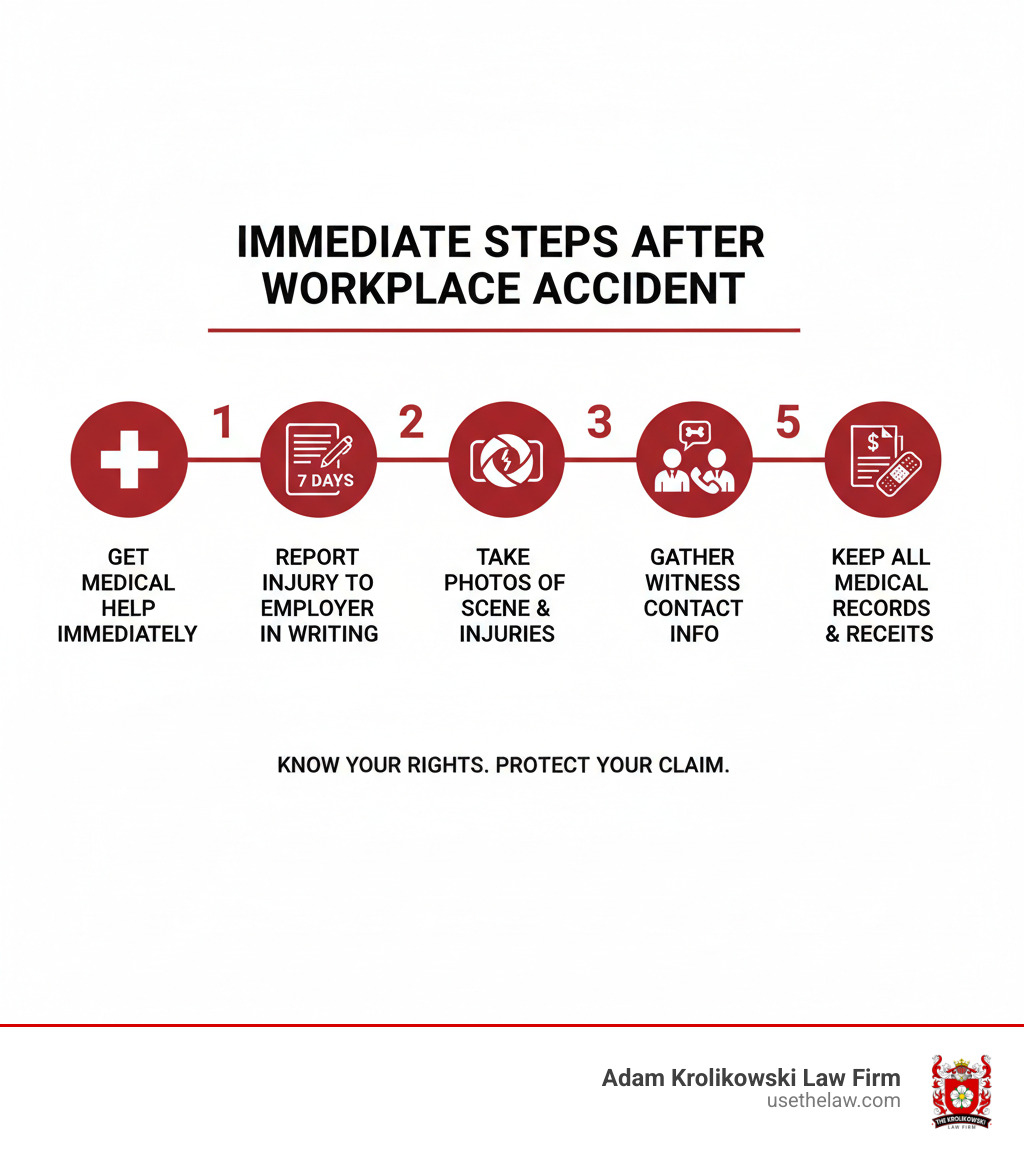
Quick Overview: Key Steps in Filing a Workplace Accident Claim
- Report the injury immediately – Notify your employer within 7-30 days (depending on your state)
- Seek medical attention – Get treatment from an approved provider if possible
- Document everything – Photos, witness statements, medical records, and incident reports
- File your claim – Submit workers’ compensation forms within 90 days to 2 years (varies by state)
- Consider all legal options – Determine if you can pursue both workers’ comp and a personal injury lawsuit
Workers’ compensation only covers some losses—typically two-thirds of lost wages and approved medical care, but nothing for pain and suffering. If a third party caused your accident, a personal injury lawsuit could provide much more. Time is critical. In California, you have strict deadlines to report your injury and file a claim. Missing them can mean losing your right to compensation. This guide will walk you through the process to help you maximize your recovery.
Know your workplace accident claim terms:
First Steps: What to Do Immediately After a Workplace Accident
The moments after a workplace accident are chaotic, but taking the right steps is crucial for your health and any potential workplace accident claim.
First, seek medical attention. Your health is the priority. Tell the medical staff your injury is work-related to create an official record. Your employer should provide a list of approved healthcare providers to ensure your treatment is covered. Next, you must report the injury to your employer in writing as soon as possible. States have strict deadlines, sometimes as short as 7 days. A written report creates a clear record that your employer was notified. Finally, document everything related to the accident and your injuries. The more evidence you gather, the stronger your claim will be.
What Documentation is Crucial for Your Workplace Accident Claim?
Meticulous record-keeping is the backbone of a successful claim. Keep copies of everything.
- Accident Report: Get a copy of the official report you fill out for your employer.
- Medical Records & Doctor’s Notes: These confirm your injuries, treatment, and the link to the workplace accident. Keep all diagnoses, treatment plans, and bills.
- Witness Statements: Get contact information and a written statement from anyone who saw the accident.
- Photographs of the Scene and Your Injuries: Use your phone to take pictures of the accident site, any hazards, and your injuries over time.
- Pay Stubs & Employment Contract: These help establish your pre-injury earnings to calculate lost wages.
Common Types of Workplace Accidents and Injuries in Santa Ana
Injuries can happen in any work environment. Understanding common accidents can help you identify if you have a valid workplace accident claim.
- Slips, Trips, and Falls: Caused by wet floors, uneven surfaces, or clutter, leading to sprains, fractures, or head injuries.
- Machinery Accidents: Occur from equipment malfunction or lack of training, often causing amputations, crush injuries, or lacerations.
- Overexertion Injuries: Result from lifting, pushing, or repetitive motions, leading to muscle strains and back injuries.
- Repetitive Strain Injuries (RSIs): Develop over time from repeated movements, such as carpal tunnel syndrome or tendonitis.
- Exposure to Harmful Substances: Can lead to respiratory illnesses, skin conditions, or hearing loss from chemicals, toxins, or loud noises.
- Vehicle-Related Accidents: A risk for any job involving driving, potentially causing injuries from whiplash to fatalities.
- Assaults and Violent Acts: Can occur in customer-facing or security roles, leading to physical and psychological trauma.
Know Your Rights: Protections for Injured Workers
The Occupational Safety and Health Act of 1970 requires your employer to maintain a workplace free from known health and safety hazards. This means they must provide proper safety equipment, adequate training, and protection from toxic chemicals. You have the right to file a confidential complaint with OSHA to request an inspection if you believe your workplace is unsafe. When you do have a workplace accident claim, your employer’s insurance is responsible for covering the costs and compensation.
Can I Be Fired for Having an Accident at Work?
No. You cannot legally be fired for being injured at work or for filing a claim. Federal anti-retaliation laws protect you from being fired, demoted, or otherwise punished for exercising your legal rights. The only exception might be if your injury resulted from your own gross negligence—extreme carelessness far beyond a simple mistake. If you believe you’ve faced retaliation, you can file a whistleblower complaint with OSHA, but you must do so within 30 days of the retaliatory action. You can learn more about filing a whistleblower complaint on the official government site.
What Are My Rights Regarding Sick Pay?
When an injury prevents you from working, several types of benefits may be available to cover lost income.
- Statutory Sick Pay: Many states, including California, mandate a minimum level of paid sick leave.
- Contractual Sick Pay: Your employment contract or employee handbook may offer more generous sick pay policies than the legal minimum.
- Workers’ Compensation Benefits: If your workplace accident claim is approved, workers’ comp typically pays about two-thirds of your average weekly wage while you recover.
- Disability Benefits: For long-term injuries, you may qualify for state or Social Security disability benefits.
These benefits can sometimes overlap or affect one another. It’s important to understand your specific entitlements under your company’s policy and state law.
The Difference Between Workers’ Comp and a Personal Injury Lawsuit
After a workplace accident, you have two potential paths for compensation: workers’ compensation and a personal injury lawsuit. Workers’ compensation is a “no-fault” system. You receive benefits for medical care and lost wages regardless of who caused the injury. In exchange, you generally cannot sue your employer. A personal injury lawsuit is different. You must prove that a third party’s (not your employer’s) negligence caused your injury. For example, you could sue a reckless driver who hit you on a work delivery or a subcontractor whose mistake injured you on a construction site.
| Feature | Workers’ Compensation Claim | Personal Injury Lawsuit |
|---|---|---|
| Fault | No-fault system; you don’t need to prove employer negligence | Requires proving negligence or fault of a third party |
| Who You Sue | Filed against your employer’s workers’ comp insurance | Filed against a negligent third party (not your employer) |
| Types of Damages | Medical expenses, lost wages (partial), disability benefits | All economic and non-economic damages (medical, lost wages, pain and suffering, loss of earning capacity) |
| Typical Time Limits | Shorter reporting and filing deadlines (days to 2 years) | Longer statute of limitations (e.g., 2 years in CA) |
Understanding which avenue applies is crucial. You can look up your employer’s North American Industry Classification System (NAICS) code and check for common workplace hazards by industry code.
What Damages Can Be Recovered?
The compensation available differs significantly between the two claim types. A workers’ compensation claim covers the basics to help you recover. This includes:
- Medical expenses for all approved treatment.
- Lost wages, typically two-thirds of your average weekly wage (temporary disability).
- Permanent disability benefits if your injury has lasting effects.
- Vocational rehabilitation if you cannot return to your old job.
Workers’ comp does not cover pain and suffering, emotional distress, or the full loss of future earning potential. A personal injury lawsuit allows you to recover these damages. You can seek compensation for all medical bills (past and future), full lost wages and earning capacity, and non-economic damages like pain and suffering and loss of enjoyment of life. This is why exploring a third-party claim alongside your workplace accident claim is so important.
Understanding the Time Limits (Statutes of Limitations)Missing a legal deadline, or statute of limitations, can end your right to compensation. The first clock starts immediately: you must report your injury to your employer in writing, often within 7 to 30 days. The second deadline is for filing your formal workers’ compensation claim, which can range from 90 days to two years, depending on your state. For a personal injury lawsuit against a third party in California, the statute of limitations is typically two years from the injury date. Don’t wait. Evidence disappears and memories fade, making it harder to build a strong case over time.
Navigating Your Workplace Accident Claim in Santa Ana
After you’ve reported your injury and received medical care, the formal workplace accident claim process begins. Your employer notifies their workers’ compensation insurance carrier, who will then review your claim and request documentation. Be prepared for scrutiny, as insurance companies aim to minimize payouts. If your claim is denied, you have the right to appeal. The appeals process in California is handled by the Division of Workers’ Compensation (DWC) and may involve mediation or a hearing before a judge. Navigating the DWC’s strict forms and deadlines can be challenging, and errors can jeopardize your benefits.

Under What Circumstances Can I Claim Compensation?
For a workers’ compensation claim, you generally qualify if you were injured while performing your job duties. Because it’s a no-fault system, you don’t need to prove anyone was negligent. This covers both sudden accidents and gradual injuries like carpal tunnel syndrome.
For a personal injury lawsuit, you must prove negligence. While you usually can’t sue your employer, you may have a claim against a third party for:
- Third-party fault: A subcontractor on a construction site causes your injury.
- Defective equipment: A tool malfunctions due to a manufacturing defect.
- Unsafe conditions: A property owner fails to fix a known hazard on a site where you are working.
- Vehicle accidents: Another driver hits you while you are working.
Pursuing both workers’ comp and a third-party lawsuit can help you recover full compensation, including damages for pain and suffering that workers’ comp doesn’t cover.
How Much Does It Cost to Pursue a Workplace Accident Claim in Santa Ana?
Pursuing a claim shouldn’t add to your financial stress. Most personal injury law firms, including ours, work on a contingency fee basis. This “no win, no fee” arrangement means you pay nothing upfront, and we only collect a fee if we win your case. We also offer free consultations to assess your case with no obligation.
For workers’ compensation claims, attorney fees are regulated by the state and are typically a percentage of the benefits recovered, paid at the end of the case. If you are a union member, you may have access to legal services through your member benefits. Your employer’s insurance coverage is what pays for your claim, not you or your employer. We are transparent about our fee structure from the start. For cases involving complex construction accident claims, we have the experience to manage the legal complexities on your behalf.
Frequently Asked Questions about Workplace Injury Claims
We’ve helped injured workers for over 25 years and have answered many questions. Here are some of the most common ones.
Can I pursue both a workers’ compensation claim and a personal injury lawsuit?
Yes, in many cases. If a third party (someone other than your employer or a coworker) was at fault for your accident, you can file for workers’ compensation benefits and also file a personal injury lawsuit against that third party. For example, if you were hit by a reckless driver while working, you could pursue both. The workers’ comp insurer may have a right to be reimbursed from your personal injury settlement, but we handle these details to maximize your total recovery.
Who is liable for workplace injuries?
For a workers’ compensation claim, liability is not the issue. It is a no-fault system, meaning you receive benefits regardless of who caused the accident. For a personal injury lawsuit, you must prove a third party was liable due to negligence. This could be another contractor, a property owner, or an equipment manufacturer. While rare, an employer can sometimes be sued directly for intentional injury or extreme recklessness, but workers’ comp is typically the exclusive remedy against an employer.
What benefits does workers’ compensation typically cover?
Workers’ compensation is designed to provide a crucial safety net. Benefits generally include:
- Medical Expenses: All reasonable and necessary medical treatment for your work-related injury.
- Temporary Disability Benefits: Wage replacement, typically two-thirds of your average weekly wage, while you are unable to work.
- Permanent Disability Benefits: Compensation for any lasting impairment that affects your ability to work.
- Vocational Rehabilitation: Job retraining or placement services if you cannot return to your former job.
Crucially, workers’ compensation does not cover pain and suffering, emotional distress, or the full loss of future earning capacity. These damages can only be recovered through a personal injury lawsuit against a negligent third party.
Get the Guidance You Need for Your Claim
If you’ve been injured at work, you’re facing physical pain, medical bills, and financial uncertainty. Navigating a workplace accident claim alone is challenging, as it involves complex rules and insurance companies focused on minimizing payouts.
For over 25 years, we have helped employees in Orange County and Los Angeles secure the compensation they deserve. We handle complex cases involving serious injuries, disputed liability, and third-party claims that other firms might avoid. Many injured workers don’t realize they may be entitled to more than just workers’ compensation. If a third party, like a negligent driver or a defective equipment manufacturer, contributed to your accident, we can pursue a personal injury lawsuit to recover full damages.
We offer free consultations and work on a contingency fee basis for personal injury claims, so you pay nothing unless we win. Time limits are strict, so don’t wait. Learn more about handling complex construction accident claims and contact us today. Let us handle the legal fight while you focus on healing.
Contact Us
Practice Areas
Recent Articles
- « Previous
- 1
- 2
- 3