


Commercial Truck Accident: 2023 Critical Guide
The Stark Reality of Commercial Truck Accidents in Orange County
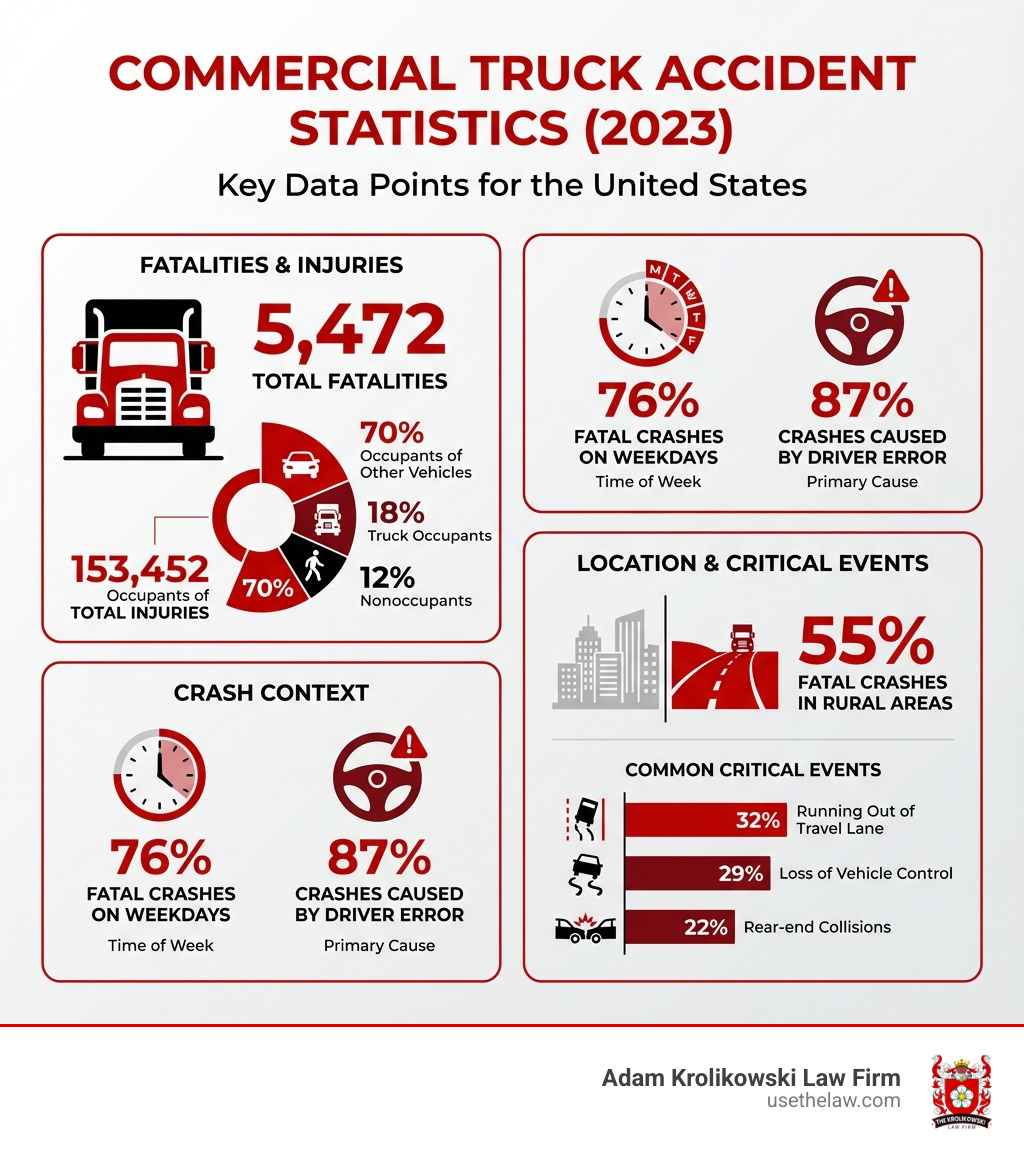
Commercial truck accidents are among the most devastating collisions on our roads. In 2023, 5,472 people lost their lives in crashes involving large trucks across the United States. The numbers tell a sobering story: 70% of those killed were occupants of other vehicles—not the truck drivers themselves.
Quick Facts About Commercial Truck Accidents
- 5,472 fatalities occurred in commercial truck crashes in 2023
- 70% of victims were in passenger vehicles, not the trucks
- 153,452 people were injured in these collisions
- 76% of fatal crashes happened on weekdays
- 87% of crashes were caused by driver error
- 55% of fatal accidents occurred in rural areas
If you’ve been injured in a collision with a semi-truck, big rig, or other commercial vehicle in Orange County, you’re facing a uniquely complex situation. These aren’t typical fender-benders. Commercial truck accidents involve federal regulations, multiple potentially liable parties, and insurance policies worth millions of dollars.
The physics alone make these crashes different. An 80,000-pound tractor-trailer needs the length of a football field to stop at highway speeds. When these massive vehicles collide with passenger cars, the results are often catastrophic.
This guide will walk you through everything you need to know about commercial truck accidents—from the leading causes to your legal rights in Orange County. We’ll explain the data, decode the complexity, and help you understand what happens when commercial trucking goes wrong.
Commercial truck accident terms to learn:
The Scope of the Problem: Commercial Truck Accident Statistics in Orange County
When we talk about commercial truck accidents in Orange County, we’re discussing incidents that have a profound impact on individuals, families, and communities. The sheer size and weight of large trucks mean that collisions often result in severe injuries or fatalities, particularly for those in smaller vehicles. Understanding the statistics helps us grasp the gravity of the issue and why these cases demand such careful attention.

The Federal Motor Carrier Safety Administration (FMCSA) and the National Highway Traffic Safety Administration (NHTSA) diligently track these incidents, providing us with a comprehensive look at the landscape of large truck and bus crashes. Their annual reports, like the Large Truck and Bus Crash Facts 2022, are invaluable resources for understanding the trends and circumstances surrounding these devastating events.
Fatality and Injury Trends
The latest figures paint a concerning, yet nuanced, picture. In 2023, there were 5,472 people killed in traffic crashes involving large trucks across the U.S. While this number is still tragically high, it represents an 8 percent decrease from the 5,969 fatalities recorded in 2022. This slight downturn offers a glimmer of hope, but the overall trend over the past decade has been one of increasing numbers.
Looking back, we saw a significant 34 percent decrease in fatal crashes involving large trucks or buses between 2005 and 2009. However, this was followed by a troubling increase of 25 percent between 2016 and 2022, reminding us that vigilance and continuous safety improvements are crucial.
Beyond fatalities, the human cost extends to injuries. In 2023, an estimated 153,452 people were injured in traffic crashes involving large trucks. This is a 4 percent decrease from the 160,608 estimated injuries in 2022, which itself was an increase from previous years. These numbers highlight the widespread physical and emotional trauma that follows these collisions. If you or a loved one in Orange County has suffered an injury in such an event, learning more about your options can be crucial. We offer resources like our Truck Accident Injury Guide to help you steer this challenging time.
Who is Most at Risk?
Perhaps one of the most heartbreaking statistics is who bears the brunt of these accidents. In 2023, a staggering 70 percent of people killed in large-truck traffic crashes were occupants of other vehicles. This means that the majority of victims were individuals in passenger cars, SUVs, or motorcycles, simply going about their day when they encountered a large commercial truck. Similarly, 70 percent of those injured were also occupants of other vehicles.
Nonoccupants, such as pedestrians and cyclists, also face significant risks, accounting for 12 percent of fatalities in 2023. This disproportionate impact on those outside the truck underscores the inherent danger that these massive vehicles pose to everyone else on the road. For families in Orange County who have lost a loved one in such a tragedy, understanding their rights and seeking justice is paramount. We can help with seeking compensation for wrongful death.
When and Where Crashes Occur
The data also reveals patterns in when and where these accidents are most likely to happen. For instance, a significant majority—76 percent—of fatal traffic crashes involving large trucks in 2023 occurred on weekdays. This makes sense, given that commercial trucking operations are at their peak during the workweek.
Time of day also plays a role. While 39 percent of all fatal crashes involving large trucks occurred at night (6:00 pm to 6:00 am) in 2022, roughly 70-72 percent of weekday fatal crashes involving large trucks consistently occurred during daytime hours (6 a.m. to 5:59 p.m.) across 2020-2023. This suggests that while nighttime driving has its own challenges, the sheer volume of truck traffic during the day contributes significantly to accidents.
Geographically, rural areas tend to see a higher percentage of fatal commercial truck accidents. In 2023, 55 percent of these crashes occurred in rural areas, a consistent trend across recent years. Additionally, a notable portion—25-27 percent—of fatal crashes involving large trucks occurred on interstate highways. These are often high-speed collisions, which can further exacerbate their severity. While we don’t have Orange County-specific statistics in our research for these trends, these national patterns provide valuable context for understanding the risks on California’s busy roadways and interstates like the I-5 or I-405, which see heavy truck traffic daily.
Why Do Commercial Truck Accidents Happen in Orange County? Unpacking the Leading Causes
Understanding the statistics is one thing, but knowing why these crashes occur is another entirely. It allows us to pinpoint areas for prevention and, in the unfortunate event of a crash, to identify potential liabilities. A landmark study, the Large Truck Crash Causation Study – Analysis Brief (LTCCS), provides invaluable insights into the primary factors contributing to serious crashes involving large trucks. This comprehensive study categorizes causes into three main areas: driver error, vehicle failure, and environmental factors.
The Dominant Role of Driver Error in a Commercial Truck Accident
The LTCCS found that driver error is overwhelmingly the most frequent critical reason for commercial truck accidents, accounting for a staggering 87 percent of all crashes where a critical reason was assigned to the large truck. This isn’t to say truck drivers are inherently reckless; rather, it highlights the immense responsibility and constant demands placed upon them, especially on the busy roads of Orange County.
Driver errors can be broken down further:
- Decision Errors (38%): These include making poor judgments, such as driving too fast for conditions (associated with 23% of crashes, with a relative risk of 7.7) or misjudging another vehicle’s speed or distance.
- Recognition Errors (28%): This category often involves inattention (which has a high relative risk of 17.1 for increasing crash likelihood) or inadequate surveillance of surroundings. Essentially, the driver fails to perceive a critical situation.
- Non-Performance Errors (12%): This refers to a driver falling asleep, being incapacitated by illness, or experiencing fatigue (associated with 13% of crashes, with a relative risk of 8.0).
- Performance Errors (9%): These are errors in physically controlling the vehicle, such as overcorrecting or improper braking.
While truck drivers are held to high standards, passenger vehicle drivers also contribute to crashes. The LTCCS found that passenger vehicle drivers had higher rates of fatigue, illness, alcohol, and illegal drug use compared to truck drivers prior to a crash. However, when a truck driver makes a mistake, the consequences are often far more severe. When a crash occurs due to driver error, proving liability becomes a critical step in seeking justice. We can provide insights into proving liability in truck accident cases.
Critical Vehicle Failures and Maintenance Issues
While less frequent than driver error, vehicle-related factors are still significant contributors to commercial truck accidents, accounting for 10 percent of critical reasons in the LTCCS. These issues often stem from inadequate maintenance or manufacturing defects.
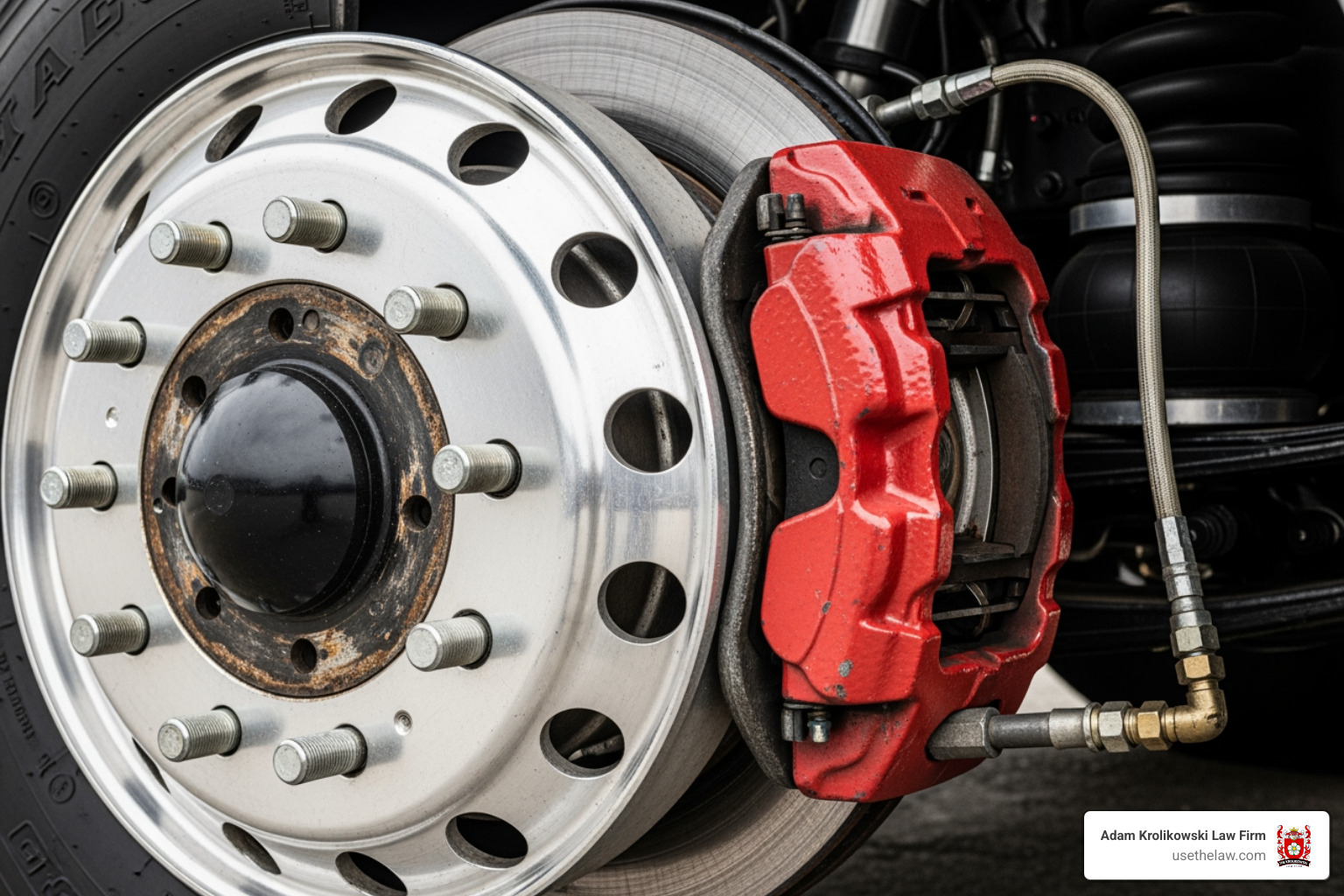
- Brake Problems: These were associated with 29 percent of large trucks involved in crashes in the LTCCS, carrying a relative risk of 2.7. Given the weight of these vehicles, properly functioning brakes are absolutely non-negotiable.
- Tire Issues: Although not specifically detailed as a critical reason in the same way as brakes, tire-related factors are consistently noted in general vehicle-related factors in crash data, highlighting their importance.
- Cargo Shift: This factor had the highest relative risk ratio (56.3) for large trucks involved in crashes in the LTCCS. An improperly secured load can become a deadly projectile or cause the truck to become unstable, especially during braking or turns. This leads directly to issues of improper loading.
- Improper Loading: Whether due to negligence by the trucking company or the shipper, an unbalanced or unsecured load can quickly turn a routine drive into a catastrophic event. For more information on this specific risk, we have resources on overloaded truck accident information and cargo loading negligence.
These mechanical failures and maintenance oversights often point to negligence on the part of the trucking company, maintenance provider, or even the manufacturer.
Driver Condition and Impairment
The condition of the truck driver before getting behind the wheel is another critical factor.
- Fatigue: As mentioned, fatigue was associated with 13 percent of large trucks involved in crashes in the LTCCS, with a relative risk of 8.0. To combat this, federal regulations, known as Hours-of-Service (HOS) rules, dictate how long truck drivers can operate their vehicles. However, pressure to meet deadlines can sometimes lead drivers or companies to disregard these rules.
- Alcohol Use: While alcohol impairment is a serious concern for all drivers, truck drivers involved in fatal crashes consistently show significantly lower rates of alcohol impairment compared to drivers of other vehicle types. In 2023, only 4 percent of large truck drivers in fatal crashes had BACs of .08 g/dL or higher, compared to 20-26 percent for other vehicle types. It’s crucial to remember that for commercial drivers, the legal limit for alcohol is much stricter: a BAC of .04 g/dL or above is a violation of federal regulations.
- Drug Use: The LTCCS identified prescription drug use (25%) and over-the-counter (OTC) drug use (17%) as associated factors in large truck crashes. Furthermore, in 2022, 6 percent of large truck drivers in fatal crashes tested positive for at least one drug, though a significant portion (58 percent) were not tested. This highlights the complex interplay of legal and illegal substances on driver performance.
These factors underscore the need for strict adherence to safety protocols and regulations. Our firm often deals with the implications of these issues, and we can help clarify the role of federal trucking regulations in your case.
The Anatomy of an Orange County Commercial Truck Accident: Critical Events and Comparisons
When we analyze a commercial truck accident in Orange County, it’s not just about what caused it, but also the sequence of events that led to the collision. These “critical events” define the immediate actions or failures that directly preceded the crash, giving us a clearer picture of how these devastating incidents unfold. Understanding these patterns, and how truck crashes differ from those involving only passenger vehicles, is key to both prevention and effective legal representation.
Common Critical Events Leading to a Crash
The Large Truck Crash Causation Study (LTCCS) identifies several key critical events that frequently occur in the moments before a commercial truck accident:
- Running out of travel lane (32%): This is the most common critical event, meaning the truck drifted or veered out of its designated lane. This could be due to driver inattention, fatigue, overcorrection, or road conditions. Imagine a truck veering onto the shoulder or into an adjacent lane on a busy Orange County freeway.
- Vehicle loss of control (29%): This includes situations where the driver loses control of the truck, often due to speeding, sudden braking, cargo shift, or adverse weather conditions. A truck jackknifing or overturning on a turn or wet road falls into this category.
- Colliding with the rear end of another vehicle (22%): Rear-end collisions are a significant problem, often caused by following too closely, distracted driving, or failure to anticipate traffic slowdowns. Given the long stopping distances required for large trucks, these can be particularly violent.
These critical events illustrate that while the ultimate “reason” might be driver error or vehicle failure, the immediate manifestation is often a loss of control or deviation from the intended path.
How Truck Crashes Differ from Car Crashes
It’s tempting to think of a commercial truck accident as just a bigger car crash, but they are fundamentally different in several crucial ways:
- Multi-Vehicle Involvement: Large trucks are disproportionately involved in multi-vehicle crashes. In 2023, 80 percent of large trucks involved in fatal traffic crashes were in multi-vehicle collisions, compared with 63 percent for passenger vehicles. This means more vehicles, more victims, and often a more complex accident scene.
- Impact Points: While frontal impacts are common, large trucks are impacted from the rear at a much higher rate than other vehicles. In two-vehicle fatal crashes in 2023, large trucks were impacted from the rear 21.2 percent of the time, while other vehicles were impacted from the rear only 6.3 percent of the time. This is often due to passenger vehicles misjudging a truck’s speed or stopping distance, or trucks slowing unexpectedly. Conversely, when a truck rear-ends a passenger vehicle, the results are often catastrophic for the smaller vehicle’s occupants.
- Driver History Comparison: While truck drivers have significantly lower rates of alcohol impairment and fewer previous license suspensions or revocations compared to drivers of other vehicle types, they do have a comparable or slightly higher percentage of previously recorded crashes. For instance, in 2023, large truck drivers had the second highest percentage (19.4%) of previously recorded traffic crashes. This suggests that while truck drivers may be more cautious about substance use and maintaining their licenses, they are still involved in a similar frequency of non-fatal incidents.
- Higher Insurance Limits: Due to the severe damage and injuries that typically result from commercial truck accidents, trucking companies carry significantly higher insurance policies than individual passenger vehicle drivers. This means that while there might be more compensation available, the insurance companies will fight much harder to avoid paying out, adding another layer of complexity to these cases.
Navigating the aftermath of such a distinct type of accident requires a specific approach. Understanding the nuances of these cases, from the initial impact to the legal processes, is why we guide our clients through every step of the truck accident claim process.
Navigating the Aftermath in Orange County
Experiencing a commercial truck accident in Orange County can be a terrifying and life-altering event. The physical, emotional, and financial toll can be immense. Beyond the immediate shock, many victims find themselves overwhelmed by the legal complexities that follow. Unlike a typical car accident, these cases involve a maze of federal regulations, multiple potentially liable parties, and sophisticated legal defenses. That’s where our team comes in, offering guidance rooted in California laws and decades of experience.
Understanding Your Rights and the Claims Process
One of the most challenging aspects of a commercial truck accident case is identifying all the parties who might be held responsible. It’s rarely just the truck driver. Potential liable parties can include:
- The Truck Driver: For negligence such as distracted driving, fatigue, speeding, or impairment.
- The Trucking Company: For negligent hiring practices, inadequate training, pressuring drivers to violate Hours-of-Service regulations, or failing to properly maintain their fleet.
- The Cargo Loader: If the accident was caused by an improperly secured or overloaded cargo, leading to a dangerous cargo shift. We’ve seen how critical this can be, as cargo shift has the highest relative risk ratio (56.3) in crash causation studies.
- The Truck or Parts Manufacturer: If a defective part, such as faulty brakes or tires, contributed to the accident.
- The Maintenance Provider: If an outside company was responsible for maintaining the truck and failed to do so adequately.
- A Government Entity: In rare cases, if poorly maintained roads or inadequate signage contributed to the crash.
Because of this intricate web of potential liability, collecting and preserving evidence is paramount. From the truck’s black box data to driver logs, maintenance records, and even the company’s hiring policies, every detail can be crucial. Navigating these complexities requires a deep understanding of state and federal regulations. For those in Orange County, we provide California truck accident attorney guidance to help solve these issues.
The Importance of Acting Quickly in a Commercial Truck Accident
Time is of the essence after a commercial truck accident. The longer you wait, the more difficult it becomes to gather critical evidence and build a strong case.
- Statute of Limitations: California, like all states, has strict deadlines for filing personal injury lawsuits, known as the statute of limitations. If you miss this deadline, you could lose your right to seek compensation forever. Understanding the specific time limits for your case is vital. We have detailed information on the California statute of limitations for truck accidents.
- Evidence Disappears: Unlike regular car accidents, commercial trucks often have “black boxes” that record vital data about speed, braking, and steering. This data can be overwritten or lost if not preserved quickly. Witness memories fade, physical evidence at the scene can be cleared, and trucking companies may move quickly to “clean up” their records.
- Witness Memories Fade: The sooner you can gather witness statements, the more accurate and reliable they will be.
Taking swift action protects your legal rights and ensures that all available evidence is secured. If you’ve been involved in a commercial truck accident in Santa Ana or anywhere in Orange County, don’t delay. We encourage you to connect with an Orange County truck accident lawyer as soon as possible to discuss your situation.
Frequently Asked Questions about Orange County Commercial Truck Accidents
We understand that after a commercial truck accident in Orange County, you likely have many questions. Here are answers to some of the most common inquiries we receive:
Who can be held responsible for a truck accident?
A truck accident claim can be complex, with potential liability falling on the truck driver, the trucking company for negligent hiring or maintenance, the cargo loader, the truck or parts manufacturer, or a government entity responsible for road maintenance.
What makes truck accident cases more complicated than car accident cases?
Truck accident cases involve severe injuries, multiple potentially liable parties, complex federal and state regulations (like the Federal Motor Carrier Safety Regulations), and significantly higher insurance policy limits, all of which increase the legal complexity.
What is the first thing I should do if I’m in an accident with a commercial truck?
First, ensure your safety and seek immediate medical attention for any injuries. Then, call 911 to report the accident, document the scene with photos if possible, exchange information without admitting fault, and contact a truck crash injury lawyer to understand your rights.
Conclusion: Navigating Your Orange County Truck Accident Claim
Commercial truck accidents are far from ordinary collisions. As we’ve explored, they are complex events driven by a combination of factors, predominantly driver error, but also vehicle failures and environmental conditions. The statistics are sobering, consistently showing that occupants of other vehicles bear the brunt of the devastation, resulting in thousands of fatalities and hundreds of thousands of injuries each year.
The unique physics of these massive vehicles, coupled with intricate federal regulations and multiple potential parties at fault, make these cases uniquely challenging. From critical events like running out of the travel lane or cargo shift to the nuances of driver fatigue and vehicle maintenance, every detail matters.
While the data can be overwhelming, the message is clear: many of these accidents are preventable. For those who unfortunately become victims, understanding your rights and the complexities involved is the first step toward recovery. If you or a loved one has been affected by a commercial truck accident in Orange County, the team at Adam Krolikowski Law Firm can help you understand your options. We are dedicated to navigating these complex legal waters, advocating tirelessly to ensure you receive the justice and compensation you deserve. Don’t hesitate to contact a personal injury lawyer in Orange County to discuss your case.